A product page that sells: turning a visit into an order
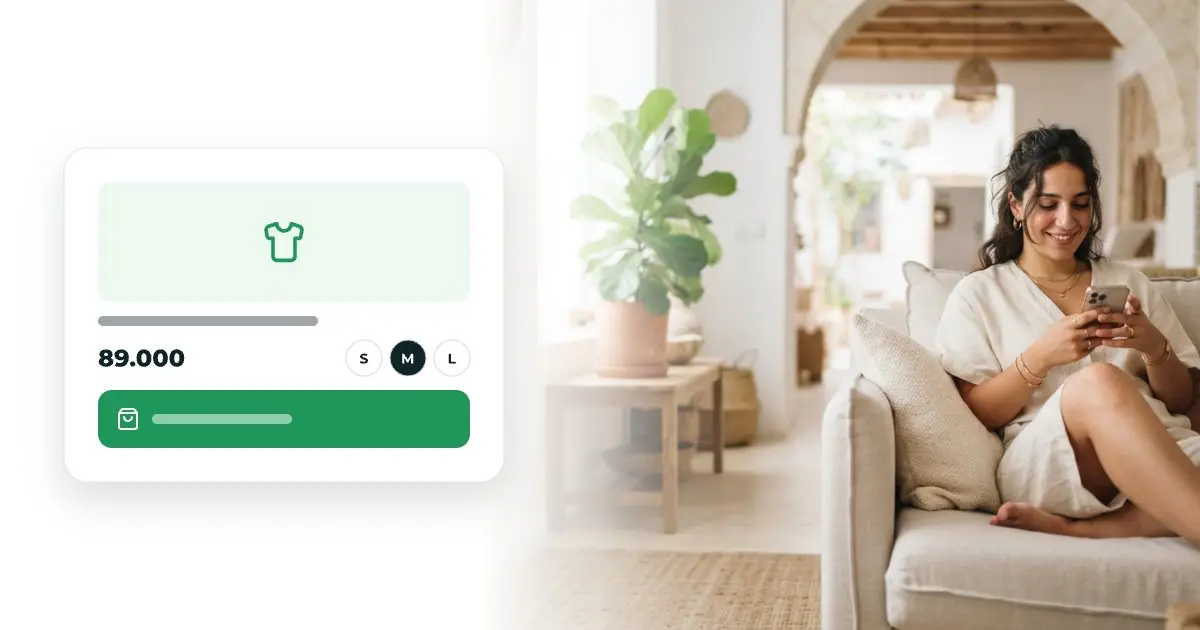
A product page that sells answers before the shopper asks: what the product is, what it costs delivered to their door, which size to pick, when it arrives and what happens if it doesn’t fit. With cash on delivery it also cuts refused parcels, because the customer receives what they expected to receive.
In short: a title that says what the product is, the price with delivery cost and time in view, two opening lines that give size, material, delivery time, payment and exchange terms, then a size guide in centimetres, variants with real stock, verified-buyer reviews, a short FAQ and a brief long description with a close-up photo or video. Photos have their own guide.
Why does a product page lose orders?
Someone arriving from a Facebook ad was not looking for your product. If one scroll does not answer their question, they comment “price?” under the post or, more often, close the tab.
The published research comes from abroad. In a Salsify survey of 1,910 US and UK shoppers run in October 2024 (its “2025 Consumer Research” report, checked in November 2026), 53% said they had abandoned a purchase because of incomplete or poorly written product titles or descriptions, and 71% had returned an item because the product content was wrong. Baymard Institute, which rates the UX of e-commerce sites (article updated March 2026, checked in November 2026), rates 52% of desktop and 62% of mobile product pages as “mediocre or worse”. We found no equivalent Tunisian measurement.
In Tunisia the mistake costs more. According to UNCTAD, cited by Tuniscope on 4 June 2026, 86% of online purchases are paid cash on delivery. An item that doesn’t match its page doesn’t come back by post: it gets refused at the door, and you pay the outbound trip and often the return. The most quoted estimate, from Tayara.tn in 2025, puts refused parcels at around 30%. A customer who receives the dress she pictured, in her size, at the announced price, has little reason to refuse it. Our payment and delivery guide puts numbers on what refusals cost.
What should a product page contain, and in what order?
Each element answers a question you already get in your inbox, in the order the shopper asks it.
| Element | The shopper’s question | Where it goes |
|---|---|---|
| Title | ”What is this, exactly?” | At the top, readable without zooming |
| Price and delivery | ”How much is it, delivered to me?” | Right under the title |
| First two lines | ”Is it my size? What’s it made of? When do I get it?” | Before any other text |
| Variants and stock | ”Do you still have a medium in sage green?” | Next to the order button |
| Size guide | ”I’m 1.65 m, which size?” | Next to the size picker |
| Trust lines | ”And if it doesn’t fit?” | Near the button or in the first two lines |
| Reviews | ”Did other people get it? Is it worth it?” | Below the product |
| Product FAQ | Whatever questions remain | At the end of the long description |
| Long description | The details, for the undecided | After everything else |
Photos come before all of this and deserve their own article: see our guide to product photos with a smartphone.
How do I write the title and show the price?
The title gives the product type, the material or feature that matters, then the detail that sets it apart. “Long linen dress, 3/4 sleeves, made in Nabeul” makes sense at once. “Yasmine dress” means nothing to someone who doesn’t know your collection. Stay under about 70 characters so it fits on two lines of a phone screen, with no all-caps and no “SALE!!!”.
The price comes with delivery cost and time, on the page itself. One line is enough: “Delivery 8 TND anywhere in Tunisia, 2 to 4 days”. Tunisian shoppers read that line before the price, as we describe in how Tunisians shop online. Find the fee at checkout and they leave, or they order feeling tricked and refuse the parcel.
A compare-at price must be one you really charged, and it goes away when the offer ends. If you are thinking of folding delivery into the price, run the numbers in the margin calculator before you touch the page. On Yalla Souk the compare-at price shows struck through, and a heavy or bulky product can have its own delivery fee.
What goes in the first two lines of the description?
On a phone, a shopper reads two or three lines before deciding whether to scroll. Those lines answer the five questions that keep coming up in your messages: size or fit, material, delivery time, payment and exchange.
Open your last 30 Messenger, Instagram or WhatsApp conversations and write down every question asked about a product. The most frequent ones become your two lines. For a dress, that gives something like:
Loose fit, sizes 36 to 44; the model is 1.68 m and wears a medium. 100% washed linen. Delivered in 2 to 4 days, you pay on receipt, free exchange within 7 days.
If you are starting from a blank page, Yalla Souk’s AI drafts a first version in French, English and Arabic; proofread it with your list of questions next to you.
How should sizes, variants and stock be shown?
Give the size guide in centimetres, measured on the garment laid flat. S, M and L vary from one workshop to the next and say nothing about the cut. Baymard notes that 42% of users try to work out a product’s size from its images, so also state the model’s height and the size they wear. Here is the guide for our example dress, to put in the long description or in the specifications table:
| Size | Chest | Total length | Advice |
|---|---|---|---|
| S (36-38) | 96 cm | 128 cm | Loose on a slim build |
| M (40-42) | 104 cm | 130 cm | Size worn by the model (1.68 m) |
| L (44) | 112 cm | 132 cm | Take L if you are between sizes |
Variants are picked with buttons. On Yalla Souk, choosing a colour moves the gallery to that colour’s image, as long as you linked the image to the variant. Keep each variant’s stock up to date: otherwise you take an order you cannot ship, and the confirmation call turns into an apology. A “only 3 left” badge helps when it is true; you set the threshold at which it appears.
What reassures a shopper who pays on delivery?
Paying on receipt protects the customer’s money, but they can still lose a day waiting for a parcel that doesn’t fit. Before ordering, they want to know you exist, that other people received the product and that they can exchange it.
Three honest reviews, one with a photo, beat ten “great!” ones. On Yalla Souk, a review from a customer who actually ordered the product carries a verified-purchase mark, and you can reply to it. Ask for the review after delivery, on WhatsApp, with the product link.
Then come the trust lines, near the button: the exchange terms in one sentence (time limit, condition of the item, who pays for the return), a phone number that answers, and cash on delivery. Baymard found that 60% of users look for the return policy on the product page itself. If your carrier lets customers open the parcel before paying, say so.
End the long description with three to five real customer questions: “Does the linen crease?”, “Machine washable?”, “Do you deliver to Djerba?”. Keep the rest short. The long description accepts images, GIFs and YouTube or Vimeo videos, and a 20-second clip of the dress moving says more than a paragraph about how the fabric drapes.
What does a rewritten product page look like?
Take a designer in Nabeul who sells linen dresses sewn in her workshop, 89 TND each, 8 TND delivery.
Before:
YASMINE DRESS NEW COLLECTION
89 TND
Top quality dress, very pleasant fabric, available in several colours. Delivery everywhere. Order fast!!!
After:
Long linen dress, 3/4 sleeves, made in Nabeul
89 TND · Delivery 8 TND anywhere in Tunisia, 2 to 4 days
Loose fit, sizes 36 to 44; the model is 1.68 m and wears a medium. 100% washed linen. You pay on receipt, free exchange within 7 days.
Colours: sage green, ecru, terracotta (one photo per colour). Sizes S, M, L, each with its own stock.
Size guide in centimetres, 20-second video worn, FAQ: creasing, washing at 30 °C, shortening the hem.
With the first version, every customer had to message her to learn the size, the fabric and the delivered price. With the second, she spends that time confirming orders.
How do I rewrite my product pages, step by step?
Allow one afternoon for ten products.
- Pick ten products (10 min): the ones with the most visits or orders, plus those that often come back refused.
- Collect the questions (20 min) from messages, comments and confirmation calls. Our confirmation call script helps you note what customers ask on the phone.
- Rewrite the title, price line and first two lines (5 min per product), with delivery cost and time in view.
- Measure and write the size guide (15 min per style), with the model’s height.
- Check variants, photos and stock (5 min per product): every colour has its photo, every size its real stock.
- Write the trust lines and the FAQ (20 min the first time, then adapt per product).
- Test on your phone (10 min), one-handed, on 4G, like a shopper who has never heard of you.
- Compare after two weeks (15 min): questions received by message, orders and refused parcels, before and after.
If your problem is volume first, with 200 products to create, start with adding your products fast, then come back here for the twenty that carry your sales.
What should I check before publishing a product page?
| Item | Good if | Common mistake |
|---|---|---|
| Title | Product type, material, distinctive detail | Collection name only, all in caps |
| Price | Real price, compare-at price actually charged | Compare-at price invented for the occasion |
| Delivery | Cost and time written on the page | Discovered at checkout |
| First two lines | Size, material, delivery time, payment, exchange | ”Top quality”, “order fast” |
| Sizes | Guide in centimetres, model’s height | S, M, L with no measurements |
| Variants | One photo per colour, stock up to date | Sold-out size still orderable |
| Reviews | Verified buyers, replies from the seller | No reviews, or copied ones |
| Trust | Exchange terms in one sentence, phone that answers | ”Satisfaction guaranteed” with no conditions |
| FAQ | Three to five real customer questions | Questions made up to fill space |
| Long description | Short, with a close-up photo or video | Supplier text pasted as is |
Sources
Checked in November 2026.
- Salsify: 2025 Consumer Research, executive summary (survey of 10 October 2024, 1,910 consumers in the US and UK)
- Baymard Institute: Product Page UX, pitfalls and best practices (updated 18 March 2026)
Frequently asked questions
How long should a product description be?
Two lines that matter, then a short long description. The first two lines give the fit or size, the material, the delivery time, cash on delivery and the exchange terms. The rest, a few paragraphs with a close-up photo or a video, is for the shopper who is still unsure. A long text copied from the supplier answers none of those questions.
Should delivery costs appear on the product page?
Yes, with the delivery time. A shopper who discovers 8 TND of delivery at checkout feels tricked and leaves, or orders half-convinced and refuses the parcel. Write one line such as "Delivery 8 TND anywhere in Tunisia, 2 to 4 days" under the price or in the first two lines.
How do I write a size guide for clothing?
Measure the garment flat, in centimetres, for each size: chest, length, and whatever matters for that cut (waist, sleeve length). Add the model's height and the size they wear. S, M or L alone is not enough, because sizes change from one workshop to the next.
Can I put a video on a product page in Yalla Souk?
Yes. The long description accepts images, GIFs and YouTube or Vimeo videos, and a product can also have its own video. A 15 to 30 second clip of the fabric moving or the object in someone's hand answers more than a paragraph does.
How do I get reviews on my products?
Ask after delivery, on WhatsApp or by phone, with the product link. On Yalla Souk, a review left by a customer who ordered the product carries a verified-purchase mark. Answer negative reviews with facts: shoppers read your reply to judge how serious you are.
Should the product page be in Arabic too?
If some of your customers read Arabic, yes. Yalla Souk keeps a name and a description per language (French, English, Arabic), and the AI can draft each one. Always proofread the Arabic: sizes, delivery times and exchange terms must match in all three.
Which product pages should I rewrite first?
The ten products with the most visits or orders, plus the ones that come back refused most often. Rewriting those ten takes about an afternoon and covers most of your sales.