Increase your average order value: upsells, cross-sells and packs
To increase average order value, offer the customer a product that completes their purchase at the moment they order: a pack, an offer right after add to cart, free delivery above a threshold set from your current average, or one more item during the confirmation call. With cash on delivery, whatever fits in the same parcel costs almost nothing extra.
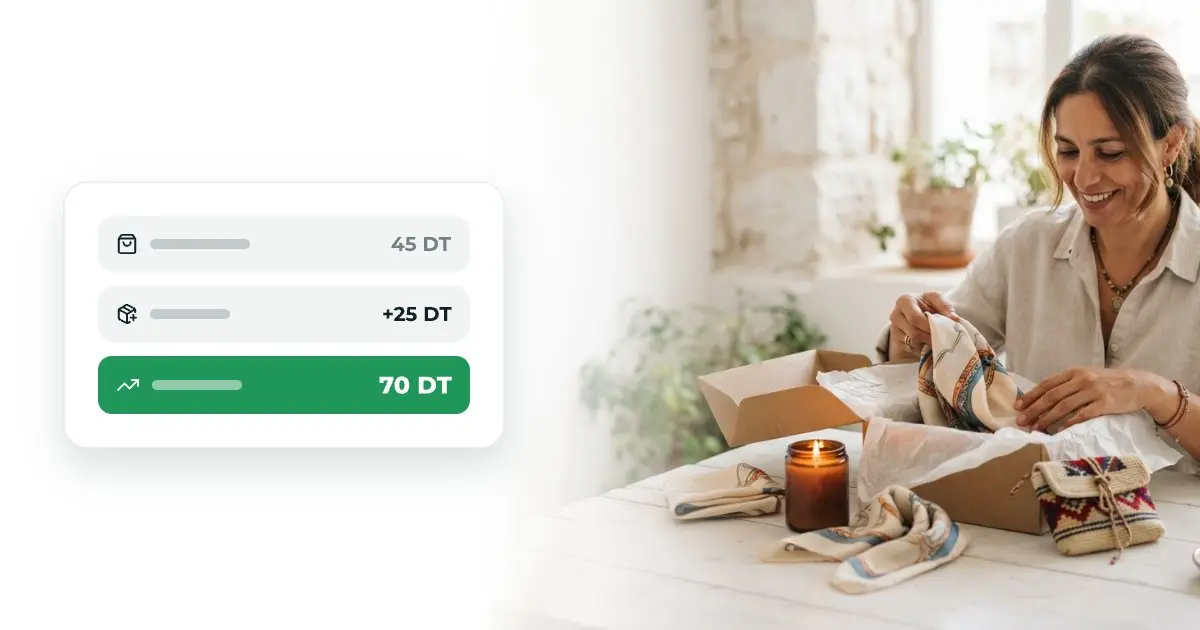
In short: a 45 DT parcel and a 70 DT parcel pay the same delivery, the same advertising and the same refusal risk. In our example, margin goes from 10.500 DT to 25 DT per delivered order. Start with one pack and one add-on offer, set free delivery just above your average order, and don’t slash prices to get there.
Why does average order value matter so much with cash on delivery?
The heaviest costs are paid per parcel: the courier, the confirmation call, and a refusal at the door that costs the trip out and back. They are the same for one scarf or three products, and the ad brought the customer in once.
Take an accessories store in Sfax. The figures follow the method in our margin calculation guide: 8 DT paid to the courier, 7 DT delivery charged to the customer, 10 DT of advertising per delivered order, a 25% refusal rate and a 12 DT round trip per refused parcel, which works out at 4 DT of return cost per delivered order. These are assumptions; replace them with yours.
| Order | Products total | Product cost | Net delivery | Packaging | Advertising | Returns | Margin per delivered order |
|---|---|---|---|---|---|---|---|
| One scarf | 45 DT | 18 DT | 1 DT | 1.500 DT | 10 DT | 4 DT | 10.500 DT |
| Scarf, candle and pouch at full price | 70 DT | 28 DT | 1 DT | 2 DT | 10 DT | 4 DT | 25 DT |
| The three as a pack at 65 DT | 65 DT | 28 DT | 1 DT | 2 DT | 10 DT | 4 DT | 20 DT |
| The 65 DT pack with free delivery | 65 DT | 28 DT | 8 DT | 2 DT | 10 DT | 4 DT | 13 DT |
The extra 25 DT of products bring in 14.500 DT of extra margin, because almost no cost moves. The last row shows the trap too: free delivery on the pack costs 7 DT, a third of the margin you gained. Free delivery belongs above a specific threshold, never on every order.
How do I work out my average order value before changing anything?
Divide last month’s revenue from delivered orders by their number. Received orders inflate the result, since some will never be paid. Write your margin per delivered order next to it, using the margin calculator if you don’t have it yet.
Then look for three things in the last three months of orders:
- products often ordered together, which are your first packs;
- single-item orders and their share of the total;
- low-priced products (under 15 DT) that sell well, because they make good add-on offers.
If most of your orders hold a single item, start with packs and add-on offers. If customers already buy several products, work on the free delivery threshold and volume pricing instead.
Which techniques raise the cart, and where do they go?
| Technique | Setup time | Where the customer sees it | Use it for |
|---|---|---|---|
| Product pack | 1 h per pack | Packs page, Packs section on the homepage, the pack’s own page | Products used together |
| Offer after add to cart | 20 min | A window that opens right after adding | An accessory or a second unit |
| Offer in the cart | 10 min (same offer) | A card at the top of the cart suggestions | Reminding those who skipped it |
| Offer before checkout | 20 min | A last screen when the customer taps Order | A small item under 15 DT |
| Related products (“complete the look”) | 10 min per product page | Hand-picked products on the product page | Fashion, home decor, cosmetics |
| Free delivery above a threshold | 10 min | Progress bar in the cart and at checkout | Any store that charges delivery |
| Volume pricing | 15 min per product | Quantity tiers on the product page | Consumables, basics, gifts in sets |
| Promo code limited to a category | 10 min | Promo code field at checkout | Clearing one category without touching the rest |
| One more item on the call | One line in your script | During the confirmation call | Customers who have already decided |
If you only have one evening, build the pack and the offer after add to cart. Those two reach the most orders for the least work.
How do I build a pack that sells?
A good pack answers a question the customer is already asking: “what goes with it?”. For a seller of abayas, that is the abaya, the matching hijab and the pin. For a cosmetics store, the cleanser, the serum and the cream from the same range.
Three pricing rules:
- Add up the separate prices and take off 5 to 10%. Beyond that, you pay for a discount that the shared delivery no longer covers.
- Check the pack’s margin line by line with the method above.
- Show the saving in dinars (“you save 5 DT”); on a small amount it reads better than a percentage.
In Yalla Souk a pack has its own page, image and translated name, and shows in the Packs section of the homepage. The pack price applies once all its products are in the cart. Watch the stock of every product in it: one item out of stock blocks the whole pack.
Volume pricing (2 for 70 DT, 3 for 99 DT) gets customers to take more of the same product. It works for things people buy again or give in sets.
What should I offer after add to cart or before checkout?
Offer a product cheaper than the one just added, related to it, at a price the customer accepts without thinking. A 45 DT scarf calls for a 10 DT pouch, not a second 45 DT scarf.
A Yalla Souk add-on offer takes a few fields: the product or category that triggers it (or any cart), the product offered, the discount (percentage, amount off, fixed price or free gift), how many units it covers, and an optional minimum or maximum cart value. You choose where it shows: the window after add to cart, the card in the cart, the last screen before ordering, or several of them. The offer list shows views, acceptances and revenue for each one.
On the product page, pick the related products of your best sellers yourself. By default the store suggests products from the same category, which often puts three scarves next to a scarf. Picked by hand, the candle and the pouch show up instead.
Promo codes can also target a single category: “10% off candles with code CANDLE10”, sent on WhatsApp to customers who already bought a scarf. The code leaves the rest of the catalogue alone and never adds to an item that is already discounted.
Where should I set free delivery?
Just above your average order, at a gap one low-priced product from your catalogue can close. In Sendcloud’s E-commerce Delivery Compass 2025 (8,000 consumers in eight European countries, checked in November 2026), 74.3% of French shoppers said they would add items to reach free delivery, and 70.5% across all the countries surveyed. We know of no equivalent study for Tunisia.
With a 52 DT average order and 7 DT delivery charged to the customer:
| Threshold | What a 52 DT cart must add | Likely effect |
|---|---|---|
| 55 DT | 3 DT | Nearly every order passes without adding anything: you lose 7 DT on each |
| 65 DT | 13 DT | One candle or pouch is enough: the customer adds a product and you earn its margin |
| 90 DT | 38 DT | Too far, few customers make the effort |
The threshold is set on each delivery method. The store then shows a progress bar in the cart (“13 DT to go for free delivery”), measured after pack savings. Show delivery fees on the product page as well: according to Baymard Institute (page checked in November 2026), 40% of US shoppers who abandoned an order cited extra costs that were too high, delivery included. Courier rates are covered in our cash on delivery guide.
Can I offer one more item during the confirmation call?
Yes, and it is often the best-accepted offer, because the customer has just said yes and is talking to a person. Do it once, at the end of the call, after confirming the order. Most calls in Tunisia happen in Derja, for example:
«باهي، الطلبية متاعك مأكّدة. حاجة صغيرة: عنّا بوشات تمشي مع الفولارة هاذي، بعشرة دينارات، وتجيك في نفس الكوليّة من غير ما تزيد في التوصيل. نزيدهالك؟»
(“Great, your order is confirmed. One small thing: we have a pouch that goes with this scarf, 10 DT, and it comes in the same parcel with no extra delivery. Shall I add it?”)
If the customer says no: «باهي، ما فماش مشكل، نبعثولك الفولارة كيف ما قلنا.» (“Fine, no problem, we’ll send the scarf as agreed.”) Then move to the next call. If they say yes, edit the order’s items before confirming it, so the cash to collect on the delivery slip is right. Our confirmation call script gives the full structure of the call.
How do I set all of this up in one week?
- Work out your starting point (30 min): average order value and margin per delivered order over the last 30 days.
- Find the pairs (45 min): products often ordered together and low-priced items that sell well.
- Build a first pack (1 h): a photo of the products together, a price 5 to 10% under the total, margin checked.
- Create two add-on offers (30 min): one after add to cart on your best seller, one before checkout for a small item under 15 DT.
- Choose related products for your ten best product pages (1 h).
- Set the free delivery threshold (15 min) on each delivery method, from the average in step 1.
- Add the offer line to your confirmation script and do two practice calls with whoever confirms orders (30 min).
- Place a test order on a phone (15 min): add to cart, offer, delivery bar, checkout. Then cancel it.
- Review the numbers after a month (1 h): average order value, margin, acceptances per offer and refusal rate.
If you are preparing for Black Friday on 27 November, the tools are the same: our Black Friday plan explains how to make an offer without cutting your prices.
What drives customers away or eats the margin?
Fake scarcity first. A countdown that restarts on every visit, or “only 2 left” on a product you have a whole box of, gets noticed fast, and with cash on delivery a suspicious customer refuses the parcel. Only announce an end date if the offer really ends.
Then unrelated products. A phone case offered to someone ordering an abaya clutters the page and triggers no add. The product offered should answer “what goes with it?”.
Avoid stacking offers too: after add to cart, in the cart, at checkout and then on the phone, the customer feels hounded. Stick to two moments.
The last trap is discounting below your margin. A pack at 55 DT instead of 70 DT leaves 10 DT with our assumptions, less than one scarf sold alone. Redo the calculation for every offer and keep the discount modest: the gain comes from the shared parcel.
What should I measure after a month?
- Average order value on delivered orders, against the previous month.
- Margin per delivered order, which should rise faster than the cart if your offers are well built.
- For each add-on offer, views against acceptances: an offer seen often and rarely taken has the wrong product or the wrong price.
- Your refusal rate at the door. If it rises, your offers or your call are pushing too hard.
- The share of orders that reach the free delivery threshold.
Next, our article on loyalty programs explains how to turn these carts into repeat orders, and the e-commerce glossary defines average order value, return rate and the other indicators used here.
Sources
Checked in November 2026.
- Sendcloud: Why delivery costs are a dealbreaker (E-commerce Delivery Compass 2025, 8,000 consumers, eight European countries)
- Baymard Institute: Cart abandonment rate statistics
Frequently asked questions
What is average order value?
The average amount of an order: revenue for a period divided by the number of orders. With cash on delivery, work it out on delivered and paid orders only, leaving refused ones out, or the figure flatters you and misleads you.
What is the difference between an upsell and a cross-sell?
An upsell moves the customer to a pricier version or a larger quantity of the same product: the box of 3 instead of 1, the next size up. A cross-sell offers another product that goes with the first: the matching pouch for the scarf, the refill for the diffuser. Both raise the cart; customers usually find a cross-sell easier to accept.
Should a pack cost less than the products bought separately?
A little, yes, or the customer has no reason to choose it. A 5 to 10% saving is often enough, because your real gain comes from sharing one delivery and one ad cost across a single parcel. Check that the pack price still covers products, packaging, delivery, advertising and returns.
Where should I set the free delivery threshold?
Start from your real average order value and set the threshold a little above it, at a gap a low-priced product from your catalogue can close. Too low and you give free delivery to orders that would have come anyway; too high and nobody reaches it.
Can I offer an extra product during the confirmation call?
Yes, once, at the end of the call, after confirming the original order. Offer a single item related to what the customer ordered, give the exact price and accept a no without pushing. If your refusal rate at the door rises after the change, stop.
Do offers stack with a promo code on Yalla Souk?
No. Each item gets one discount at most: pack, volume price, promotion, add-on offer or promo code. A promo code only applies to items that got no other discount, so an already discounted pack is never discounted a second time.
What acceptance rate should I expect from a cart offer?
We know of no reliable public figure for Tunisian stores, and it varies a lot with the product offered and its price. Run an offer, compare views and acceptances after two to four weeks, then change one thing at a time: the product, the price or where it shows.